Showing posts with label housekeeping. Show all posts

My Best Laundry Tips -- How To Keep Your Clothes Looking (Almost) Like New Longer


Ever since I have been paying much more attention to the quality instead of quantity in my wardrobe, it is important to me that the pieces last longer. I think that nothing ruins your look as run-down pieces.

Learning how to do laundry right is simple, but learning about it took ages. There is hardly any resource with a simple overview of things such as detergent ingredients and temperature. Labels on the clothing are misleading. And did you know that the pH of the detergent is really important?

I sort my laundry into:
White
Coloureds
Woolens and silk
Delicates* and viscose*
Household linens and heavy fabrics 

The basics:

Fabrics and detergents:
Plant based fibers need a basic pH and animal fibers (wool, silk) need acidic pH level detergents.
Animal fibers cannot withstand higher temperatures.
Energy saving washing machines (European ones) don't actually go up to the temperatures on the buttons. So it you are running a 60° program, it will not actually heat the water up to 60°, but it will mimic a 60° cycle through longer washing times etc. This is one reason why detergents like wash-nuts often "don't work" if you just add them straight into the machine.
Wash nuts are only effective if the actual water temperature is at least 40°c, moreover they are very acidic so they are not suitable for plant-based fabrics. Chestnut detergent is pretty good, ivy detergent made my skin itch slightly.
Powder detergent has been shown by many tests to be more effective than liquid ones because they contain ingredients that would deteriorate in a liquid product. Also they are much more environmentally friendly -- less packaging, and you aren't transporting water over long distances.
Perfumes and harsh detergents cause a lot of skin issues, from acne to dryness, so I really would advise you to switch to ecological detergents.
I don't use bleach, it's really not healthy for you or the environment.You don't actually need to disinfect anything you have been wearing on sleeping in, it has bacteria that you already have on your skin. For whitening I use oxygen bleach and the sun.
Newly bought fabric items are literally doused in chemicals, wash at least once before wearing.
Wool naturally resists dirt, and can be worn several times without washing. Wearing a tank top below protects it from sweat. Same goes for woollen socks: wear a cotton one below.

Clothing care labels:
These are misleading, for example you can safely machine-wash most hand-wash-only and dry-clean-only items. I do this all the time and have never destroyed an item. The labels list the most conservative washing method, and have more to do with legal regulations that the actual item.

How I launder my stuff:

My goals:
Keep my clothes nice-looking longer
Be kind to the environment
I own a Miele washing machine, very stable but not very modern and not very fast. There is a clothesline outside and one inside in the cellar (it is illegal to dry clothes indoors due to danger of fungus as the apartments are really well isolated). I don't own a dryer. I have kids so I usually do several loads of laundry per week.

Delicates:

Most of my personal clothes get the royal treatment since I buy them with great care and I don't grow out of them. I actually wash most of my personal clothes (except jeans) on a separate load -- on the delicate cycle. The delicate cycle doesn't spin dry, so the stuff takes longer to dry (3-4 days in the winter), but I don't care as long as it looks better longer. 
I use mesh bags to contain anything with lace or anything extra delicate. I also put anything with a zipper or hooks in mesh bags. Bras go into thicker bra bags. 
The detergent I use depends of the fabric. If there is no viscose I'll use the coloureds detergent, otherwise I'll use one meant for delicates and wool.
I always add one of these reusable colour-absorbing towels into the wash, they seem to catch quite a lot of dyes! It's basically a small white terrycloth towel, it's snow white when you buy it and it turns darker with every wash.
I also put a dash of white vinegar into the rinse cycle, I found that it cuts down on the lint!
I hang up most of my clothes in the shade.
If you want your bras to last forever, you should use a detergent-free lingerie wash, here are some recommendations. The only bra I hand-wash is the Parfait Affinitas Charlotte because I love it so I'm terrified that I won't be able to replace it with exactly the same model and colour.


Wool and Silk:

These absolutely have to be washed separately from other clothes. Both wool and silk are protein-based, and need a detergent with an acidic pH level. Moreover neither can stand much agitation or higher temperatures -- wool will felt if you are not careful. So you absolutely must use the wool program on the washing machine and a detergent especially for woollens. Add a bit of vinegar to the rinsing cycle to keep the wool soft and to prevent felting. Do not use a drier!
You can also use wash-nuts for wool and silk, as they are acidic. However the temperatures for the wool program are too low to activate the wash-nuts, so you need to first soak them in hot water for 15 minutes.
To soften wool you can try adding hair conditioner to the rinse. To soften really scratchy items, soak them in a mixture of  hair conditioner and glycerin, and don't rinse out.

Whites:

I use a detergent especially for whites for this, as it does not contain ingredients that prevent leaching of dyes. I usually add a bit more sodiumpercarbonate (oxygen bleach) and allow the clothes to soak (soaking program) for a couple of hours (most whites-only detergents contain this already, but I like to add more). The sodiumpercarbonate works instantly in temperatures over 40°, but it will also work in cooler water if you give it a few hours time (you can test this out with stained coffee cups!). I buy mine in the Müller or organic stores, it goes under Sauerstoffbleiche in Germany, you can also buy it dirt cheap online and it has so many household uses. For example I soak the horribly discoloured cooking stove knows in it and they look snow white.
I love to hang up white laundry on the line in the summer, preferably wearing a white dress and singing. The sun bleaches out a lot of the stains, especially baby underwear.


Coloureds:

Household linens, and most clothes of my family members come into this category. 
Again I let the clothes soak with sodiumpercarbonate, interestingly it takes out stains but doesn't affect the colour.  And soaking is always good, I think. I use a colour detergent, it contains ingredients that prevents dyes from bleeding. I use the generic 30-40°c wash cycle, with plenty of spinning at the end. I usually hang up the items outside in the shade, unless it's a really nice item that I don't want to fade.

Viscose:

You can't wash viscose with a regular detergents as they contain cellulase. Cellulase is an enzyme that removes the pills from cotton fabrics but will break up the cellulose in the viscose. That's the reason you see the weird pills on viscose if you don't wash it correctly.
Contrary to what people often say, viscose isn't particularly fragile and I find that as long as I wash it on the delicates cycle it doesn't get misshapen or anything. I usually wash viscose together with other delicates.

Here are two more slightly different methods of cleaning that I thought I'd include because they are really useful:

Sun washing:

The properties of the UV rays of the sun are so underestimated. You know how bedding gets all fresh and crisp when you hang it out in the sun?  The UV rays kill of mites, bacteria, fungus, they dry up moisture and leave everything smelling good. I put all my bedding (pillows, blankets etc) in the sun once a week, once a month I sun my cushions, small floor mattresses, carpets and the removable parts of the sofa. I find that doing this gets rid of the vague unfresh smell that often lingers in homes.
I usually use the weather forecast to play this ahead of time, I don't want to deal with wet stuff if the rain comes.

Snow washing:

If you have a carpet, the snow can be a great (and free) way to clean it. It really works as long as you make sure that temperatures are actually below freezing, and that you let the carpet cool down first. Here is a good tutorial.


   Does this sound like a lot of work? It is and yet it isn't. I make my kids bring up and Konmari-fold and put away their own laundry, so at least that's something I don't have to do myself. I don't wash most of the stuff after just one wear, apart from underwear, socks and things work on very sweaty days. Bedding gets washed only once a week, and again I get the kids to help.
   Finally I wanted to say that I'm sick all week and when writing this I realised that being sick makes me forget how to grammar. So I'm sorry of the English in this post is weirder than usual.

Photo credit: Gratisography

My Favourite Green Home Cleaning Products


   I love cleaning products, and I enjoy hanging out in the household cleaners section of stores, hoping to spot some nifty new product that I'll fall in love with. However I have pretty high standards -- my cleaning products must be non-toxic, and I really prefer multi-purpose cleaners because I just don't have the space to store hundreds of specialised products.
   In the past years I have been testing out many household cleaning products in hope of finding something that is both non-toxic and actually works. Here are my favourite products:

Orange oil

   Orange oil cuts through grease like a knife, plus it leaves everything smelling divine. Undiluted it can remove even really stubborn glue from labels, for everything else you dilute it with water. I use it to clean the floors and the surfaces in the kitchen and bathroom. The good stuff (oil without additives) it a tad pricier but is really worth it, one bottle lasts for a really really long time. The original one is the Oranex from Hobbythek, I also use the one from AlmaWin.

Coir scrubbie

    This little scrubbie beats almost all brushes that I have owned. I have several and use them to clean vegetables, pots, awkward bathroom corners, and my bike. They are surprisingly durable, don't get mildewy and almost completely biodegradable (except the wire). I originally discovered them through Kaufmann Mercantile (a store full of amazing but ridiculously overpriced products), but found much more affordable ones on Ebay directly from Sri Lankan sellers. A few days back I found one for less than 3€ in my local Denns (organic supermarket).

Magic erasers for everything

    This magically clean the dirt from everything, from sport sneakers to the fridge -- everything except really soft surfaces. Really magic. They

Microfiber cloths for everything

   Do a really good job of picking up dirt, and you can use them solo (just wet) on everything. I especially love them for cleaning windows and mirrors.

Vinegar + Cornstarch for cleaning windows

    Cleaning windows and mirrors with vinegar is old news, but adding cornstarch to the mix that makes the glass really sparkly and streak-free. This works really well for me, even though my windows are always extra dirty because of sticky little hand prints and fruit-fly poo. Here is the recipe.

Astonish Oven and Cookware Cleaner for everything in the kitchen and bathroom

    Based on silica clay, it does an amazing job of cleaning tiles, the ceramic and the steel sinks, the bathtub, it also removes rust. The brand is from the UK and I bought it from a local construction market, but I never found it there again. Now I get them off Amazon.

Natural hand cleaning paste to clean really greasy hands

    You know the times where your hands are smeared with machine grease and you try to clean them with dish washing detergent? At a house that I visited I spotted this hand cleaning paste which was basically made out of sawdust + clay, and it got rid of even the most stubborn grease. Since then I have been looking for that product and the closest I got to it is the Profiline Bio Handwaschpaste which has just three ingredients: sawdust, clay and glycerine. Ecover also offers a nice hand cleaning paste. If you have access to sawdust, it is pretty easy to DIY such a paste, I have seen several tutorials on the internet.

Gall soap to remove stains from clothes

    It does an amazing job at removing stains from clothes. I still have the bar I bought seven years ago. Frosch came out with a vegan alternative.

Soap nuts for the laundry

   I love them, and they love my clothes back. They are extremely eco-friendly, perfect for babies or anyone with sensitive skin, and they make an amazing shampoo that is acidic and leaves the hair extremely soft and shiny. They are also anti-fungal, repel insects and are very gentle to fabrics. The downside is that they work only with warm water, so if you want to run your load with cooler water you need to pre-soak the nuts in hot water to release the saponin. Here is some great info on soap nuts, including a cost breakdown.

Molto Fügen Versieglung grout sealer

    It was really really hard to find a grout sealer that wasn't full of very toxic chemicals, and the one from Molto has pretty good ingredients. I cleaned my bathroom and kitchen grout really well and used this to seal it. The grout stays clean for a really long time, until the seal wears off.

Mellerud Schimmel Entferner mildew spray

   According the Öko Test, this was the only product that worked against mould and mildew and was not hazardous to health. It is basically Hydrogen peroxide with surfactants, you just spray, leave on for a few minutes, then wipe off. I recommend using gloves because the H2O2 can lightly irritate the skin. This product is also great for the weird black stain that you get on grout in the bathroom.
  You could also use up to 10% strength hydrogen peroxide, however I find that the surfactants make the mildew easier to remove.

That's all from me! What are your favourite household cleaning products?


I Threw Out Half Of My Clothes, aka Review Of The Magic Of Tidying Up By Marie Kondo + Extra Tips!


   Last year I was singing the praises of having a plentiful wardrobe, my summer closet was bursting at its seams with pretty stuff, I was regularly editing out items that I didn't like or that didn't fit and I had a well-curated wish-list that would bridge the gaps in my wardrobe.. I wanted a bigger closet and more hangers for my summer stuff, and I definitely had too few winter clothes. I thought that once I fulfilled these wishes, I would have the perfect effortless, practical and stylish wardrobe.
   Then I read The Magic Of Tidying Up by Marie Kondo, a small tome written by a pint-sized soft spoken cross between a fairy godmother and a dominatrix. Since then half of my clothes have been sold or donated, my closet is beautifully arranged with items that I love, there is plenty of free space and I even have the luxury of keeping some cold-weather clothing there for chillier days (it's normally stored in the attic). I also got rid of half of my (already slim) winter wardrobe. Shockingly, I almost always have the right thing to wear, it takes me minutes to pick out an outfit, and it gives me joy to see my closet with lovingly-arranged pieces that I love. I still can't get over the surprise. Marie Kondo's method is like peeling away layers of everything that was weighing me down, what is now left are all the pieces that are right for me, and surprisingly (or not) they all match and flow together. I actually deleted my wishlist since after some months I noticed that I didn't need most of those items any more.

   If I were to recommend just one book on taking care of your home, your wardrobe or any other possessions, The Magic Of Tidying Up would be it. It is very different from other uncluttering and organising books I have read, it changed my approach to my belongings. The book is written simply and gracefully and reads really smoothly. It's Japanese-ness and her Shinto background makes it quirky, at least to westerners -- but I find it delightful.

   What I like best about the Kondo method is the feeling I get afterwards -- a feeling of lightness and happiness, like a pleasant after-taste. Her method puts you into a happy and grounded happy mental space and doesn't stir up guilt or fear.  And from what I have I have seen, other people also report getting a Kondo-ing high.
  And this feeling and her methods spill over to other areas of life -- I have very few urges to shop, I rarely buy things unless they are just right, and I have a much better radar for what "just right" means. I feel a quiet satisfaction from the things that I already own, at least in the categories that i have already Kondo-ed.


by Carli Jean

   What's so special about The Magic Of Tidying Up? Marie Kondo's method connects you to your actual desires. Asking "does it spark joy" is a simple yes or no question which connects us with our actual desires, and bypasses the whole guilt and backward-logic of the brain. If you use the regular approach while uncluttering and organising, your logical mind will remind you that you should be wearing those shoes even if you aren't yet, that they cost you good money, and that black pumps are a classic and versatile basic that every woman should own. With Marie Kondo's method, your emotional response will go "I don't actually even like these shoes. They feel uncomfortable." And you are free to let them go, even if they cost a lot or are a present from your best friend.

   Also, Marie does not tell you what you should and shouldn't keep -- if a collection of rubber ducks or pink crocs bring you joy, you keep them. She just tells you that if something is in your home, it should be because it gives you joy or makes your life meaningful in some way. When you own what you love and love what you own, your surroundings are an expression of yourself and you live intentionally.

"The question of what you want to own is actually the question of how you want to live your life. Attachment to the past and fears concerning the future not only govern the way you select the things you own but also represent the criteria by which you make choices in every aspect of your life, including your relationships with people and your job."


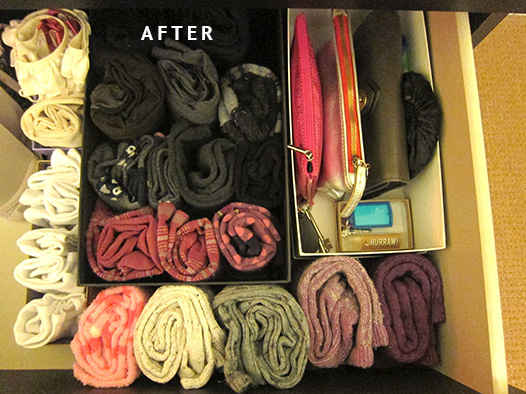
Marie Kondo recommends a very specific way of folding clothes, which saves a LOT of space and is surprisingly easy to maintain. This is the drawer from the bloggers of AsianCajuns, who have done the whole Konmari cure!

   The Life Changing Magic Of Tidying Up taught me about that Japanese way of being mindful towards material objects. I am often careless and unmindful with my things and then get upset that they get damaged or misplaced. But I was fascinated by glimpses of the deliberate, simple and mindful Japanese approach: the concept of Wabi Sabi, the sparsely elegant aesthetics of their products, the way my Aikido teacher smooths and folds his Hakama, the slow movements of the tea ceremony I watched at a Japanese cherry-blossom festival, the beauty of the endlessly patched Boro. The Magic Of Tidying Up is a beautifully simple introduction to this way of life.


   You need to read the whole book to understand the method, as there is much more to it than just "does it spark joy". I have noticed that people online who just read an article about the method often misinterpreted the instructions and were missing a lot of information. The book has a lot of big and little tips, for example little rituals to help you let things go, a really great approach to gifts, and most importantly the explanation of how some things have already fulfilled their purpose the moment they are received or bought.


A couple of tips for those that have read the book and are Kondo-ing their life:

* "Spark of joy" can also mean a quiet satisfaction, or thankfulness for the work the item does. For example you might not exclaim with joy when you see your ugly juicer but drinking fresh carrot juice every Saturday is something you really enjoy.
* It really helps to take a moment to "warm up" before discarding, to get into the right frame of mind. Marie Kondo greets her apartment and claps, but you can do whatever you like, for example taking a moment to imagine how you want your home to feel like; simply breathe in and out for a moment, play with your wind chimes, whatever calms you and helps you to concentrate.
* I like to start the tidying session with an item I really love. As I take it into my hands, caress it and smile, I immediately get a "reading" on what the "spark of joy" feels like.
* It's ok to have a "maybe" pile. However I strongly suggest dealing with it at the end of the uncluttering session and not leaving it till another day. At the end of the session you are in a flow and will make better decisions, if you leave the pile till the next day it's just a fear of dealing with the stuff, plus the pile will just bug you and make you feel guilty.
* The sushi rolling method is easy for kids to do, and they rummage less when they can see everything
* Her rule of decluttering by category and not by space is also genius, since otherwise I would never have realised that I own over twenty votive holders that were scattered all over the place. Don't ignore that rule.
* She is right about the socks. Two of my friends who knit their own socks tell me that they would never ball up the socks because it loosens up the tops, so there is something in that.
* Kids can learn to Kondo too, in fact my daughter is much better at it than I am. I think it's a valuable tool to teach them!


    For those of you who have already read the book, you'll be happy to know that at least one more book will be available in English soon. Meanwhile you might like her talk as well as her Reddit AmA, both have some extra tips and answer some questions. Oh, and here is how she shops.

   Any other Marie Kondo fans out there? Did you like the book? How much did you purge? What is your favourite bit of Konmari advice?


Obsessed About Turkish Peshtemal Towels


    A while back I talked about using microfiber towels for the hair to prevent frizz, and also mentioned that old T-shirts are also great for this. However since a while Turkish cotton towels have been overtaking my home and replacing all other towels.

   Peshtemal are traditional flat-woven linen or cotton towels, used in Turkey in Hammams. I think they are called Fouta in Tunisia. They are thin and very sturdy, have the typical stripes and fringe on both ends. And they are amazing. For one, they do a great job drying the hair and the body and are more absorbent than regular towels. I even use them in the kitchen because of that! When it comes to frizz, I think they are as good as microfiber or T-shirts (I'd love some curlies to weigh in on this!). If you like to turban your hair after washing, Turkish towels stay tucked better than regular towels.
   Another thing I love about Turkish cotton towels is their versatility -- they don't look very towel-y and so they can be used as a picnic blanket, a beach towel, a sarong, tablecloth, you name it. They are also extremely small and light, so they are perfect for travelling.
   Peshtemal towels are extremely sturdy and long lasting and get softer with every wash. My regular towels had to be replaced yearly because they don't look nice any more, however the Peshtemals look brand new (granted, I got ones in a darker colour, but still). They also dry really quickly, which makes them great for winters. Plus, they look really chic in the bathroom. Really, there is no downside, unless you like your towels fluffy.
   I own a couple big Turkish towels for the shower, one colourful big one for picnics and the like, a couple small ones as hand towels for the kitchen and the bathroom, plus one luxurious one with silk in it that I got as a gift -- I use that as a cover-up for my Osteopathy sessions. (Osteopathy is my recent discovery -- it has helped me a lot with back pain and neck stiffness brought about by uneven shoulders and hip joints.) I'm also testing out a Peshtemal in the gym, but it's a bit too light and slides off the back rests of the machines -- though I do love how little space it takes up in my gym bag.

   I got some inexpensive Peshtemal towels from ebay, but I also see them sold in Weltladen and of course Turkish stores. They may feel stiff when you see them in a store, but after a wash they soften up. You can get small hand-towel size ones for as low as 6€, the bigger ones cost a bit more -- although I have seen the prices really jacked up in fancy stores. You will probably find it in those stores run by and for Turkish / Arabic / other Middle Eastern people.
   Another kind of towel that is pretty similar to the Turkish Peshtemal towel is the Huckaback towel. Also the Indian Gamcha or Lungi, although it is much thinner.

  So, does anyone share my love of Turkish towels? Do they work well for your hair type?

Photo credit

Tuned-down Boho Style {Fashion & Interior Inspiration}


Simple boho. Isn't than an oxymoron?
     Bohemian is a style that appears prominently on my Pinterest pins, but not in my real life. It is too maximalistic, too fussy, too flashy. My dressing sense is a bit more urban, ladylike; and I prefer my small and un-minimalistic home to look light, airy and calm. It's hard to work Boho into it. I'm also wary of the Hippie look which looks a bit too scruffy and faded to my eye, and also with all my years of living in India and my green-crunchy life style I am already at risk of being classified as a Hippie. (I've got nothing against Hippies, they are lovely people, it's just not "my thing".)
    Yet I am so drawn to the exotic colours of the Bomehian style, the warmth and vibrancy and the richness. Traditional patterns and workmanship from far-off cultures. It ties in strongly reflects my wanderlust and my interest in other cultures. And as me and my husband both have roots in other cultures and have lived in several different parts of the world, many of the items and patterns are meaningful to me. I do own many boho items: pretty fabrics, jewelry, embroidered clothes, masks and figures and whatnot. Yet I seem to be at loss at how to incorporate them into my wardrobe and my home.
   So I started browsing Pinterest for images of a simple, minimalistic boho style. Modern boho. Minimalistic boho. Bohemian combined with rustic, with industrial, with rock, with classic elements. this is what turned up:

  There are several ways of making bohemnian, gypsy and tribal look calm, simple and even minimalistic. You can stick to small doses and splashes of vibrant elements: a couple of cushions or a throw; or just a bag or a statement necklace.

via ILoveBornToBeWild

via Emmadine

via ana-lopo  

via Etsy


    You can use contrast, combining rich and exuberant pieces with tougher, simple items, or classic pieces. Think gypsy elements with white walls and organic wood; a beaded jacket with black (p)leather trousers, industrial furniture.

via Etsy
via ThatBohemianGirl
via Colormuse

via TheBerry


   Or you can choose bohemian pieces that are by themselves simple. Either simple metallic geometric jewellery, or very delicate dreamy pieces. Rich patterns in either neutral or subdued colours. Or just stick to a monochrome palette.

via Style-Files

via ThatBohemianGirl

mage: Westelm, via Stylzimoblog  


My point is: you can use gypsy, bohemian and ethnic elements in many different ways. You can make it elegant. You can make it tough. You can make it simple. Have fun! I'm off to make my own boho pieces work.

   What's your favourite way of using boho elements in your home and in your outfits?


A Lazy Girl´s Guide To Gardening


    I´m lucky enough to own a garden. A lovely one. I also happen to be lazy minimalistic when it comes to gardening. I fully belive that the garden is mean to serve me and not the other way around.
    Over the years I have collected some great tips for minimising the work on my garden. I almost never water anything, except for freshly planted stuff. I weed very little, mostly I just remove the ones that are in the way of the expansion of my ground covers. And my garden is a lush little paradise! I always feel sad when people tell me they find their gardens a lot of work as in chores, the unpleasant kind), because I realise that usually they make gardening into a chore. gardening can be  (almost) effortless!

    Here are tips for those that want to get most out of their garden with minimum of work:

* Ground covers are your friends.

    Ground covers keep weeding and watering down to a minimum, since you won´t have any bare patches of soil that dry out and invite wild seeds. Ground covers also make the garden look lush (again, no bare earth). Some (like clover) naturally fertilise the garden or help other plants in some way. My favourite ground cover is wild strawberries, which have the most divine taste on earth. Second place goes to Waldmeister (Galium Odoratum) (a lovely patch in my garden) for its delicate foliage  its ability to spread and bloom even in the shade. Oh, and it tastes great in wine.

* Pick your (weed) enemies:

      I only pull out ones that are very ugly / annoying / aggressive, and leave the rest. I don´t have time, folks, I have a blog to run.

* Work with the weather

      Best time to pull up weeds is after rain, when the soil is soft and wet. The best time to plant stuff is before rain, since you won´t have to water it every day.


a part of my garden

* Know your garden

     Which gardening zone are you in? What is the pH of your soil? Is it sandy, heavy, dry or wet? Do you realise that different parts of your garden have different micro climates -- a corner near stones will be warmer, a patch near a pine tree will be more acidic, some parts get way more sun than others, parts will be wetter than others. Work with that, and choose plants that like those conditions. I like Dave's Garden for that kind of info!


* Don´t plant anything that needs a lot of TLC

     Needs to be overwintered in the greenhouse ? I´m too lazy to do that. Needs constant fertilising / watering / friendly conversations? Sorry, still too lazy. Get stuff that thrives easily in your micro climate. Peeking into neighbouring gardens is a great way to see what grows best in you area.

* Don´t bother with a neat, formal garden

      It´s way too much work. A more natural garden can look gorgeous even if you forget to weed it for weeks. Let yourself be inspired by English gardens and nature. Let plants seek out the best spots for themselves. If you have followed the two previous steps, your garden will surprise you by it's natural beauty.


* Plant bulbs

     Spring and summer bulbs are some of the most easy to plant and care for. Spring bulbs like crocuses, narcissus and tulips come up when there is nothing else growing anyway, and then die down to make place for other plants. Summer bulbs are lovely too, my favourite being purple alliums.

* Annuals are rarely worth it

      Unless they are tasty / drop-dead-gorgeous / self-seeding. Or you have too much time and energy on your hands. Perennials have to be planted once, and they last for years!

* Plant something edible

      I love berries because they are easy to grow and so tasty, and normally berries are very expensive to buy in the stores. Same goes for mediterranean herbs (don't need almost any attention at all), as well as fruit trees.


    Over to you: do you have a green thumb? What are your favourite plants to grow?


How To Organize The Home As A Visual Processor


Organize The Home As A Visual Processor


    Did you know that how you process information best can help guide how your home should be organized? I'm process things visually, and I really wanted to share my tips on managing my home without going crazy. Incidentally, these tips are also great for people with ADD/ADHD. Curious? Head over to SITS girls to read How To Organize The Home As A Visual Processor.
    If you have tips of your own to add, please share! I adore organizing and playing house!


Chores You Shouldn't Be Doing


chores you shouldn't be doing


     There are several household tasks which take a lot of energy yet give nothing back. I also know several lovely, intelligent women who work their behinds off and yet insist on doing these tasks. To know which chores you can cross off your to-do list without guilt, hop over to the SITS girls and read my guest post on chores you shouldn't be doing!


Reader Question: Table For Floor Seating


I had this pop into my mailbox a while back:

 I read in one of your posts that you use a floor seating arrangement in your home, and I am interested in learning more about how to set one up. Pillows, and actual floor SEATS are easy to find online, but I have been having trouble with tables. If you use a table in your setup, where did you get it, or did you have it made? What height is it from the ground, and do you find it to be a good height?
I am very concerned about table height. I've been trying to research floor seating, especially what height a table ideally should be, and I've not found much of anything. 

Here is my reply:

 Hi there, first we used a random second hand coffee table which worked well for two adults but as the kids grew it became too small for a family meal. Then we bought an IKEA table and cut the legs -- it is the Bjursta table, the table top can be extended. The table is 46cm high, but I feel it is a mite to high and plan to cut it to around 10 cm lower. Our floor seating is 10 cm high --- take the height of yours into account before you cut the table. I'm not sure about what the ideal height should be, but I find that it has something to do with how much lower your elbows are when you sit from the table top. You can see what that distance is on your dining table and desk, and whether you find that comfortable. When in doubt, keep the table higher, it is always easier to cut more off or make the seating higher, that to deal with a table that is too low.

    Hope this helps you. I'd love to know how it turns out.


Clean Greasy Pans With Mustard Powder


   It's been a while since I've posted anything domestic, so here is a sweet tip from my Russian friend:  mustard powder is the BEST thing ever to clean greasy plates, pots and pans. It absorbs the grease much faster than most detergents I've tried. I put a teaspoon or two (or three, if the pan is very big and very greasy) and spread it around with a brush, then rinse off. A slight mustard-y smell remains, so I like to follow with a quick wash using a tiny drop of detergent (to which I always add eucalyptus essential oil).
    If you can't buy mustard powder (mine is from a Russian shop), it's pretty easy to grind mustard seeds in a coffee grinder. Mustard powder is normally used to make mustard, which is a very important part of the traditional south German breakfast (pretzels, white sausages, mustard and beer).


How I Organise My Belts and Headbands (Pull-out Hook Rack Love)


Remember how I showed you how I hang my necklaces on the Ikea Komplement pull-out rack ?


     These hooks are genius because they stay flat on the side of the wardrobe wall when not needed and can be pulled all the way out so that you can reach whatever is hanging on the very last hook.

    I got a two more of these pull-out hook racks (wanted more but there were only two left) to organise more stuff. 
   Here are my belts:


And here are my bandanas, headscarfs and crochet berets:


   I want to get a couple more when I'm at Ikea again. I am thinking of hanging up bracelets, tank tops and... I wonder what else I could store like that ?


PS Pardon the irregular posting. I am doing overtime theater practice and helping to organise a hoopdance convention and that takes up most of my time and creative juices.

Photos by Eternal*Voyageur


Living Green


   Trying to green is an important part of my life, though it wasn´t always this way. I have had episodes in the past where my husband snatched away air freshners that I was happily wielding, not aware of all the crappy chemicals in them. Since then I am learning to live a bit greener and healthier each year, bit by bit. Very few of these changes are actually sacrifices I make for the planet. Many were decisions made to save money (anything that saves electricity), or just because it´s more efficient (menstruation cup) or healthier (organic food).
   Living in Germany means I am by default greener than inhabitants of many other western countries (energy is expensive here, packaging of products is regulated by the govt and line drying is easy) but still I know I could do more. I have lived in countries where people live much more simply and sufficiently, so it pains me to see how much is wasted in the West.

    I made a list of things of green changes that I have implemented since I have my own home (and these changes make me really happy). I also made a list of some of the many things that I could do better. At the end of the year I will review it and hopefully I will have improved.

My green efforts:

Around The Home:

  • Using baking soda & vinegar to clean, or eco-friendly cleaning products.
  • Reusing packaging material.
  • Buying as much organic food as I can afford.
  • Organic & mostly local fruit & veggie box with almost no packaging arriving at my home every week :)
  • Energy-saving bulbs in half of the lamps at home.
  • Giving away instead of throwing away (freecycle, asking people, or putting things out on the curb).
  • Microfibre wash cloths for the home and my face.
  • Commuting by public transport.
  • Eating vegetarian food that is high in raw plants and low in animal products.
  • Avoiding soy.
  • Buying secondhand very often (ebay, flea markets, people I know, thrift stores).
  • Using cloth diapers part of the time (this is one of the few things on this list that takes an effort to do).
  • Not buying drinks or bottled water (the tap water in my town is really good, BTW).
  • Eco-friendly laundry detergents that come in refillable packs :)
  • Sorting my trash with care and disposing of problematic stuff like old medicines responsibly. (I know: duh, but I´m still surprised at how many people don´t).
  • Bricks in the oven & bottles of water in the fridge to cut energy usage.
  • Not using drier cloths / paper napkins etc
  • Using rechargeable batteries almost exclusively.
  • Power strips almost everywhere to prevent energy draining.
  • Always shopping with cloth bags.
  • Passing on all magazines that I have read.
In The Garden:
  • Collecting rain water in the garden for watering plants.
  • Not watering the garden (apart from container plants & newly planted stuff). The trick is to not have even an inch of exposed soil, there is something growing everywhere and I never plant anything if I read that it needs watering all the time. Ok, I´m also too lazy to water anything regularly).
  • Composting raw food leftovers.
  • No chemical pesticides or fertilisers.
Personal Stuff:
  • Thrifting a LOT, for clothes as well as for stuff for the home.
  • Organising clothes swaps.
  • Using the cup.
  • Mostly natural personal-care products.
  • Always having my Sigg bottle with me.
  • Using mostly natural / alternative medicines
  • Trying to buy ethically when I can afford it.


What I would like to change:


  There are probably a million things that I´m not so happy about and want to change. Here are the things on my mind right now:

  • Switch my bank to a more ethical one, or at least one that doesn´t invest in nuclear energy.
  • Long and hot showers, need to be shorter and cooler.
  • Have the computer on standby more often.
  • Be more efficient while washing dishes.
  • Toilet train kid no.2 soon.
  • Think before I buy stuff, to minimise throwing away stuff that very soon broke / I don´t want any more.
  • My favourite teas come in tea bags that are individually packaged >:(
  • Forgetting to bring my non-disposable coffee cup.
  • I should access online supermarket newsletters instead of picking up paper versions.
  • Research which chocolate brands are slavery-free.
  • Stop accepting free crap. Even if it´s free, it´s still crap.
  • Try Furoshiki with thrifted scarves instead of gift wrap.


Things I wish I could do, but not really possible right now:

  • Buy in bulk. Not an option for a lot of things, besides I still haven´t dealt with the pantry moths. Besides, I don´t have a car. (Ok, in the end I´m still greener).
  • Top loading washing machine, not going to get replaced by a front-loader any time soon.
  • Stop buying from cheap stores that carry stuff probably made in sweatshops.
  • Heating the house a lot in the winter (kids love to wear as little as possible by day and won´t stay covered at night).

     Any ideas of not-too-difficult changes I could make ?


All Money Is For Spending, Aka A Budgeting Epiphany


Kind of appropriate for this blog, don't you think ?  ;) 

    I recently realised why it was so hard for me to save. It's the concept that our money should be divided into "to spend" and "to save". Spending means exchanging the money for things that we need and make us happy. Saving means keeping, holding. It also means denying oneself of the joys of spending it. A hungry piggybank or bank account swallows it all up.

    But in reality there is no such thing as saving. All money will be spent, sooner or later. When we "save" money, we are simply deciding to spend it as a later date (or to give it to someone).


   "Later" spending is often more meaningful than a lot of the now spending. It either provides for future emergencies, or fulfills longterm dreams. "Now" spending (I'm talking about the ones after necessities like rent, food and medical bills have been paid) is impulse oriented. Or rather advertising-controlled.
    We get pulled in two directions: spending the money now, or later. "Later" spending is usually more planned, and dream oriented. Like that house you'd like to own, or that holiday you'd like to take. Or even that fabulous dress you're saving for. Immediate spending ? That coffee calling to you on a cold day. That latest "must-have". A gadget that "might" be useful. They make us feel good for a moment, but often leave us empty. I read a study somewhere that we make better decisions when we decide for the future, as compared to decisions for the present. Makes sense, doesn't it ?
    I'd say that a lot of "later" spending is more "you". Do you ever dream, thinking "If I had more money, I would..." Yet chances are that you already have some of the money for these things, you are just choosing to spend it on something else.

     Before your next purchase, take a moment to think about your long-term dreams and wishes. You can spend 50€ on that dress (now) or on that trip to Rome (later). You will spend every cent you have, sooner or later. So it's up to you to decide where you want to spend it. If you do buy that dress, don't complain that you can't afford Rome. You just chose not to.

     There is no bank account or piggy bank swallowing up all that money you deny yourself the pleasure of spending. It is all yours, a treat waiting for the right moment. Like that chocolate cherry on the cake that you are saving for the last bite.


   Does spending come easy to you ? Do you squirrel away your savings into a bank account or a piggy bank ? Do you ever have the feeling that companies are conspiring to make you spend your money as fast as possible on trifles ? Have you ever kept money in your bra ?


Photo from nowaygirl    


How I organise the mess of daily, weekly, monthly & annual tasks


   We are often told to divide our tasks according to how often we need to do them. I had some problems with this approach:

   Too many lists ! I am a visual processor with attention deficit problems. When I see too much stuff, it irritates me and I tend to ignore it.
   Logistic problems: where do the bi-weekly and bi-yearly tasks go ? How do I divide the monthly tasks into manageable chunks ? This leads to:
   Procrastination:  When I saw a big pile of weekly or monthly tasks looming, I either got virtuous and tried to tackle it on that day (fail), or I but re-scheduling them on other days messed up my lists even more.


Now I have a different method:


   Instead of trying to organise all my tasks into different categories, I focus on each task separately. I decide how often it has to be done, and when exactly (every thursday, or every 1st january). Then I forget it, until my scheduler reminds me of it.

   Every time I add a recurring tasks, I only need to think about how often I want to do it. Then I choose a day that would suit the task and has a free window of time. Cleaning the bathroom is every Monday. Washing the trash cans is every 30th of the month. Updating the medicine cabinet is twice a year: 15th April and 15 Oct.
  Once it's added to my list, it won't appear and bother me until it's time to actually do it.

   I let todoist manage my tasks. I love it because it's uncluttered, easy to use, and yet has some powerful features. (Which you can totally ignore if you don't need them --- unlike some services which make you set a priority or due date on everything). It's really easy to get several different overviews of your tasks (by list, by tag, by due date, by priority, etc)

   I use different lists for different tasks (like a list for my hoop-dance moves that I want to learn, or gardening tasks, or kids-oriented, and so on). But these are only for getting an overview. They integrate seamlessly into my daily task list.

    When I open my to-do list, I simply see what I have to do each day. Everything has a rhythm, and no day is over-filled.

  
   Do you have a way to deal with tasks that are not daily ? Which is your favourite planning software -- or do you prefer pen and paper ? Do you like to have a "monthly / annual chores day", or do you prefer to sneak these tasks into your daily schedule ?


Hangin´ My Hat


    I finally figured out a cute and practical way to store my hats. In the colder month they are in the cellar, and when the spring they double as decor in the entryway.

Photo by Eternal*Voyageur


Todoist, the Zen-est of task managers


Warning: this love letter will be very interesting for all the other Penelopes. If the word "organized" disturbs you, just escape.

   I use Todoist manage my to-do lists, plans, as well as affirmations and motivating images . I love it because it's uncluttered, easy to use, and yet has some powerful features. I think that Todoist really nailed Einstein's "Everything should be made as simple as possible. But not simpler." And this simplicity makes Todoist a really flexible and powerful tool.

   When I was looking for a task manager, I signed up for half a dozen free online services and did some test runs. They all fell through at some point. Then Unclutterer pointed me towards Todoist.


Why I´m such a fan

   I chose Todoist because of its simplicity. There are no distractions. Adding a task is easy, especially with keyboard shortcuts. Also, it's really easy to get several different overviews of your tasks (by list, by tag, by due date, by priority, etc). I love that you aren't forced to use these extra features: if you don't need to use lists, priority, sub-tasks, tags, you don't have to. You can even add tasks without a due date (Yay ! can you imagine that many scheduling software doesn't let you do this ? Am I the only one who doesn't know when she will finally feel like making that book clock ?) 

   Also, I dig how Todoist understands typed commands such as "thurs", "every day" or "every 25". (Granted, if the event is biweekly, bimonthly or biyearly I have to add it twice).


   To organise stuff, I can create sub-tasks. And sub-sub tasks. And lists can have sub-lists. The sub-tasks can be collapsed to cut visual clutter.

    I can add tags such as @errand, @home @computer or @husband. If I'm going out with an errand, I can look up @errands to see what else I can do on the way. 


How I use Todoist

Since Todoist has become my life command center, I will show you how I use it for different things:

I put in everything that I have to do, want to do, or just think about doing someday. 

Tasks that I I do regularly are set to repeat. I water the plants every Tuesday. Translating a text that I'm working on is on wed.Cleaning my house is divided into chunks for each day of the week. Updating my medicine cabinet is twice a year. I also add reminders to wish people on birthdays, buy gifts, send cards. And then I can forget them until they pop up.
I save mental energy by not having to think about when was it last that I had vacuumed the fridge coils or watered my dracaena.


Lists ahoy !

    I also use Todoist as a list maker. That's right, random, rambling lists. Books and movies that sound interesting. Hoop tricks (along with video URLs) that I want to master. Things that sound interesting enough to try them some day. Blog post ideas. A wish list. A gardening list with all the garden tasks & chores arranged by month.
   I can change these items into to-dos: when I decide that I want to work on this hoop move on sunday afternoon, I just need to add a date next to the item. And it will appear in my to-do list on that day.


Inform and inspire

   Those scraps of wisdom, pretty quotes and affirmations that you're told to write some place obvious ? They're on my Todoist. A quote on saving appears on Mondays. Astrological advice to re-check everything during Merc retrograde appears daily during that period. I´m so happy I thought of this because I never notice stuff when it´s on my bulletin board or my notebook.

   This is why I love Todoist. Did I mention it's free ? I also like their about page.


Check these out: