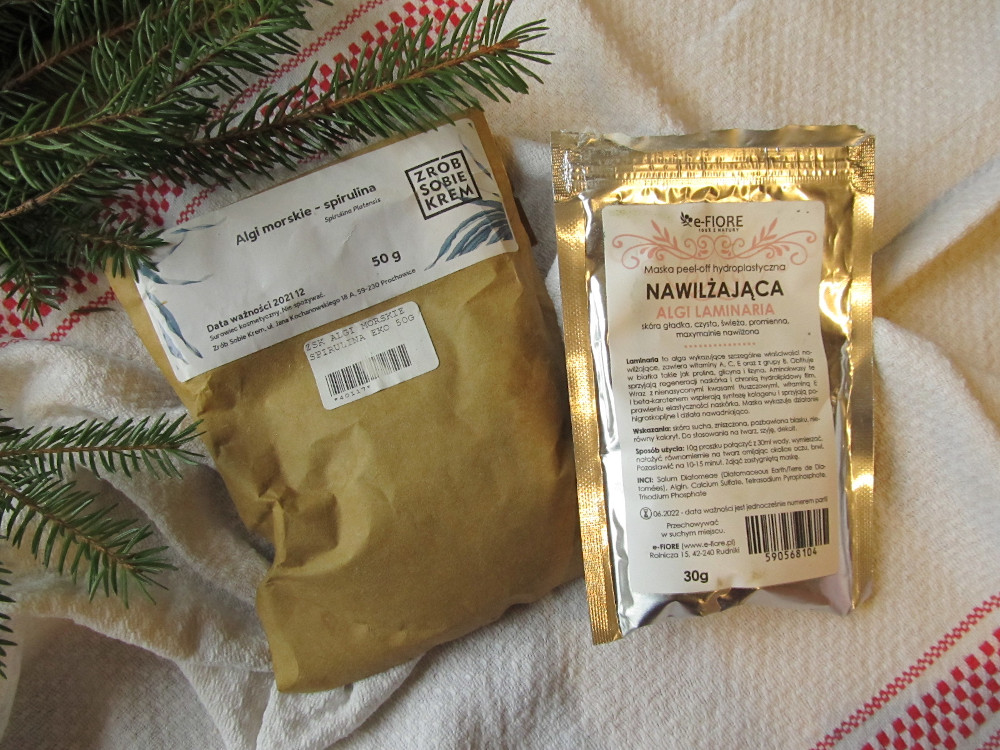
In this post I'll be talking about exfoliating products for the scalp with enzymes and acids, as well as how to improvise when you can't buy these products where you live.
Here is a chance to learn from my mistakes. It literally took me a couple of years to learn to take care of my greying hair. Maybe I missed all the advice because I've gone grey much earlier than my peers. It kind of sneaks up on you -- at first all you have to do is decide between dyeing or not. But when grey hair hits critical mass, you might start wondering why it's acting out and not responding to whatever worked before.
My high porosity hair was always very happy with a lot of proteins: protein-rich conditioners, beer rinses, yoghurt masks. With time it wanted less of those things, I thought it was because the porosity decreased as the damaged sections grew out. But as recently my favourite high-protein Kallos masque made my hair really unmanageable, I realised that it can't just be porosity. My hair never was and never will be low porosity even when super healthy, it has a lot of texture and curls.
I recommend these scrub ingredients because they are easy to wash out unlike other ingredients like coffee grounds, ground nuts, etc.

I already posted about me frying my hair last summer due to bicycling around town without a hat. Hair, especially greying hair, is highly susceptible to UV damage. Note that I live in a relatively cold climate and we don't even get that much sun.
This winter I was diagnosed with eczema and after a couple of different
treatments the one that was most effective was UV light on the scalp.
After a while I noticed damage -- my hair was dry and coarse.
If you have greying hair (doesn't matter if you dye it), your hair is bleached or damaged, or if you live anywhere with a lot of sun, or spend a lot of time outdoors, this post is for you.


Solid products have moved from the hardcore backpacker/environmentalist niche to being the new hot thing, so I wanted to write a little about my experience with them.
The big plus point for solid bar products is their lower environmental impact-- low to no packaging, instead of a big plastic bottle, half of which is water that is transported halfway around the globe, you get a little bar in a cardboard box. Solid beauty products are dry and concentrated, this imo justifies the often slightly higher cost-- they usually last longer, volume-wise.
But lets talk about ingredients. Solid products usually don't need preservatives, because they are dry. Other than that, the formulations are often very different than those of conventional products. It's also important to note that a solid product is not automatically natural -- seem of them contain ingredients like SLS so make sure you check the ingredient list or look for products organic certificates.
I love these so much. While regular soaps are formulated to get heavier dirt off your hands (from cooking, cleaning, etc), solid bath gels are much gentler and usually have a neutral pH level. Unlike soap, they don't dry your skin and feel pretty much like regular shower gel when you wet them. They feel luxurious and creamy, just like shower gels. I love them so much that I don't think I'll be switching back to regular soap for my body again.
Lotion bars are very moisturising and you should absolutely try them if your skin is dry. They are best used after showering or while actually in the shower. Combined with heat and water they go on easily and seal in the moisture. I like to rub the block in my hands as if I were lathering soap, this makes the bar melt. Then I apply as usual. I feel like the lotion bars seal in the moisture very effectively, and in the winter I feel like they keep me warmer. This might sound weird but someone pointed out that when your lips are cold and you apply balm, they stop feeling cold. So it's kind of like that. The downside is that the application does take a couple of extra minutes, and is not so nice if your skin isn't wet. Anyway, I don't think my skin has ever been so moisturized as it has been this winter.
These are actually two very different products. Hair soap is soap, it has a basic pH level and honestly I haven't met any hair-care addict who was happy with it. As it raises the pH level of the hair, you need to rinse your hair with vinegar to neutralise the pH level. This shifting pf pH levels isn't kind to the hair long-term. Hair soap also performs really badly with hard water.
Solid shampoo is formulated much closer to shampoo. There are a lot of very different formulations out there, so it might take some testing to find one your hair likes. Most of them give the hair more texture than slip, and can leave the hair a bit matte and cause build-up over time. However there are plenty of people who swear by shampoo bars, so if you feel like giving them a try, do! Pick ones without sulfates or sodium bicarbonate. Other ingredients to look out for is protein -- some hair types love it some hat it, I wrote more about that here. In the German-speaking market the
These are formulated with solid ingredients such as coconut oil, shea butter or stearyl alcohol, which makes them heavy. To solve this, some manufacturers add ingredients such as sulfates to make the bar lather, which is not very kind to the hair. I feel that if your hair is very dry, you can try out hair conditioners in a bar. If your hair is easily weighed down, skip this category.
This is a very individual product -- I find that natural deodorants are so personal, what one person swears by may not work for another person at all. Personally I have had a lot of success with the solid deodorants from Lush.
Fun! There are a couple of kinds out there -- while for travelers the little tablets are the most practical, I personally like powders a lot. There is also tooth soap, and while it tastes disgusting it has helped me with some gum issues. I don't really want to give out much advice here as this is more of a medical product than a beauty product, but I really encourage you to explore low-waste tooth care.


I always air dry unless it's an emergency, because heat is one of the biggest causes of damage.
The three techniques -- scrunching, plopping and clipping give me curls and lift, while the other products prevent frizz and maintain the curl.
Of course when I have time I add extra products and steps like acidic rinses and scalp treatments. But it's really nice to have a barebones routine that doesn't take up much time and pretty much always works.
Your mileage may vary, based on your hair type and climate. I have super healthy coarse, textured hair with medium porousity (used to be high but I fixed it with lots of care), and get haircuts to thin out my hair and bring out the curl. I live in a moderate continental climate. So this post is not a prescription, but an invitation to find your own basic routine.
You've probably heard that over-cleansing dries out the skin. And but what if I told you that cleansing in two steps can work really well for those of you with dry skin? Read on to find out why double cleansing can actually make the skin less dry, and what common product not to use.
* You get a thorough but gentle cleanse by using two super gentle cleansing products that don't strip the skin instead of one harsher one.
* You'll need less active ingredients (that are often drying) in the rest of your skin care, because double cleansing reduces clogged pores, cysts, blackheads and general skin tone.
* Double cleansing removes residue of makeup and sunscreen, which often contains drying ingredients.
Hey everyone, this post is filed under "I can't believe I haven't blogged about this yet".
Clipping is my favourite way to get volume at the roots without using heat (my second-favourite being going to sleep with wet hair spread behind me on my pillow, which unfortunately gives me a slight cold).

One of the best things I have done for my skin is double cleansing. The science behind is that some impurities are better dissolved in oil, and others in water.
Unless you live in place with pollution-free air and use no products on your face whatsoever, I recommend trying it out. If you already have tried double cleansing and weren't excited, I still invite you to read this post and see double-check if you have done it correctly.
Before I get to the how, here are a couple of reasons double cleansing is important:


A small obsession of mine are slow, dark remixes of fun upbeat songs. I'm not sure how it started, but I began keeping a mental collection of covers that skew dreamy, electronic and dark. Here are my favourites:
I think it all started from this song. When Daft Punk asked their fans to make covers out of their electronic dance piece Get Lucky, Daughter put her own unique spin on it, and gave us this mellow, minimalist version that puts a dark twist on the originally upbeat lyrics. I was mesmerised, and mildly obsessed how reinterpreting the song worked.
The original by Animotion is a forgettable little 80s number. The version by Karen O (from the Yeah Yeah Yeahs) that was the intro of Flesh And Bone -- an amazing, but very dark series about ballet -- translated it into a moody and dark piece. I also think the video is pretty cool.
A long time back I wrote a bit about hooded eyes. Now I have some fresh ideas that I want to share:
A hooded eye is not just little space on the moveable lid. It means that the unmovable lid looks pillowy -- however this is often not very obvious, especially on younger people. The more clear sign of the hooded eye is that the crease is longer than average, it extends to the outer corner of the eyes. This makes applying regular eyeliner impossible -- if you draw it on with your eyes closed, it will look very strange when you open your eyes (and vice versa). (I'm not going to talk about east Asian and monolid eyes here, because this is a whole big topic I'm absolutely not qualified for.)
Before I delve into actual makeup, I want to say that I always find it a pity when people approach hooded eyes as something that needs to be fixed. I find this eye feature is very charming, it is a very specific look and has not been called "bedroom eyes" in vain. A lot, and I mean really a lot of gorgeous famous women have hooded eyes -- from actresses to supermodels to singers.
I found it a pity that Renee Zellweger got work done that took away this distinctive feature of hers. I mean she is a beautiful woman and looks great still, but she looks so, I dunno, rather generic Caucasian now. Not to mention that her original eye shape that she felt the need to fix is due to her Kven and Sami heritage, which is another conversation all together.
Ok, off my soapbox and back to makeup.
Many hooded eye makeup tutorials will tell you to apply a dark, matte shade on the unmoveable eyelid to make it recede. This is the standard "corrective" makeup for the hooded eye:


I'm writing this post because some of my family have been diagnosed with a vitamin D deficiency, with one family member having extremely low levels.
If you live in a country where you don't get much sun during the winter, you might be feeling sluggish and moody during the cold half of the year. And might be chalking it up to things like spending so much time indoors, the cold and the darkness. But actually a lot of people living in the higher latitudes are deficient in Vitamin D -- this paper suggests 41,6% of people in the US. And double that number of black people -- research shows that the more melanin your skin has, the less it absorbs the ultraviolet radiation that is needed to synthesize vitamin D.
* An AHA or an enzyme product to exfoliate. If you are doing this in the winter, and committing to using sunscreen you can pick a product with alpha hydroxic acids. I use one I made myself. An enzyme product can be used all year, also on dry and sensitive skin. I like Orientana's papaya and ginseng scrub, or ___________
* A 2% BHA product to dissolve the sebum. I use Vianek's normalising cleansing gel. You can use Stridex strips, the Paula's Choice 2% BHA Liquid Exfoliant, Logona Aktiv Pickel-Stopp Bio, or diy a BHA toner.* A clay mask to draw out the gunk from the pores. The Queen Julep mask is very popular for this, I use Kaolin clay.* Oil to dissolve the remaining sebum. I use either sunflower, jojoba or grapeseed or my own mixes, but you can use any face oil that works for you.
0. Start with clean, product-free skin. Remove any dead skin cells on the surface with a cotton or microfibre face cloth, a soft brush, a konjac sponge or gauze or a silicone scrubby.1. Apply the AHA or enzyme product and leave it on for 15-20 minutes. This will act as a mechanical peel and loosen dead skin cells from the surface.2. Apply the BHA product on the areas with clogged pores. Leave on for 15-20 minutes. The BHA will penetrate the sebum in the pores and loosen it.3. Apply the clay mask, keep it on for 10-15 minutes. Spritz it with water and don't allow it to dry out. This will draw the gunk out of the pores to the surface. Clean off the clay with a cloth.4. Apply oil on your face and gently massage with your fingers for 2-5 minutes. At this point some people start feeling "grits", which is sebum and dead skin cells. Wash off the oil. You can do this with a washcloth dipped in warm water, or with micellar water or another cleanser.